
What happened at the beginning of time?
The question of origin of life has captivated humanity throughout history. While science explores the mechanisms of cosmic beginnings, Scripture addresses the more profound questions: Who initiated existence? Why does anything exist at all? What was the world’s original state? Genesis opens with one of the most consequential statements ever written: “In the beginning, God created the heavens and the earth.”
Before Time Began
Remarkably, the Bible suggests something existed before time itself—God. “In the beginning was the Word, and the Word was with God, and the Word was God,” John’s Gospel declares. Before matter, energy, space, or time, there was divine relationship—Father, Son, and Holy Spirit in eternal communion. This means creation wasn’t born from divine loneliness or need but from abundance, love, and creative intention. God didn’t create because something was lacking but because giving, creating, and loving flow from His nature.
Creation from Nothing
Genesis 1 describes creation ex nihilo—out of nothing. Unlike ancient myths where gods shaped pre-existing chaos, the biblical account presents God speaking reality into existence. “Let there be light,” and light appeared. This establishes that creation is fundamentally contingent, dependent on God’s sustaining word. Nothing exists independently or by accident. Everything that is, is because God willed it and spoke it forth.
Order from Chaos
The earth initially existed in formless void—tohu wabohu in Hebrew—darkness covering the deep. Then systematically, God brought order: separating light from darkness, waters above from waters below, sea from dry land. This pattern reveals God as a God of order, purpose, and design. The creation account moves from chaos to cosmos, from emptiness to fullness, from disorder to beauty. This has profound implications: the universe isn’t random but purposeful, structured by divine intelligence.
The Rhythm of Creation
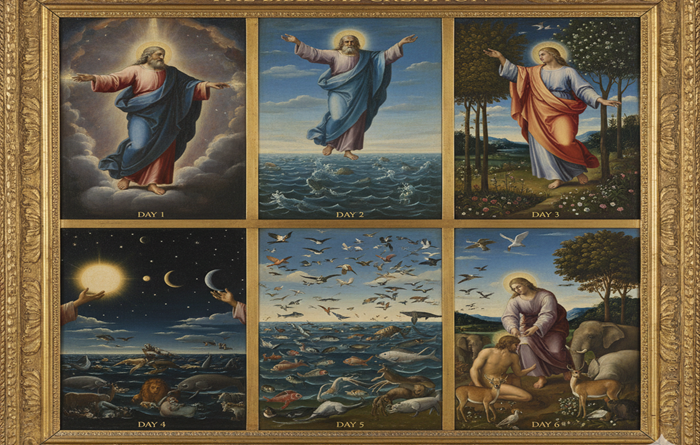
Creation unfolded over six days—not necessarily 24-hour periods but distinct creative acts with intentional progression. Each day concluded with “And God saw that it was good.” This repetition emphasizes creation’s inherent goodness. The material world, physical existence, our bodies—all were pronounced good by their Maker. This counters philosophies that view material existence as inferior or evil.
The progression itself is meaningful: light, sky, land and vegetation, celestial bodies, sea and air creatures, land animals, and finally humanity. Each stage prepared for the next, revealing divine wisdom and forethought.
The Crown of Creation
The sixth day brought humanity’s creation, distinctly different from everything prior. “Let us make mankind in our image, in our likeness.” Humans alone bear God’s image—not physically but in capacity for relationship, creativity, moral reasoning, and spiritual awareness. We were created for communion with God and stewardship of creation.
Significantly, God created humanity male and female, establishing relationship and partnership as fundamental to human existence. He blessed them, commissioned them to “be fruitful and multiply,” and gave them dominion—responsible authority, not exploitative domination—over creation.
The Sabbath Rest
The seventh day introduced rest, not because God was exhausted but to establish rhythm and meaning. The Sabbath declares that existence isn’t merely productivity but includes worship, reflection, and enjoyment of what’s been made. God rested and invited humanity to share that rest, establishing a pattern for human flourishing.
Everything Was Very Good
After completing creation, God surveyed everything and declared it “very good.” The world began in perfection—no death, suffering, corruption, or brokenness. This original goodness establishes that evil and suffering aren’t inherent to existence but intrusions, distortions of God’s good design.
Conclusion
At the beginning of time or the origin of life, God initiated reality through creative word, establishing a cosmos of order, beauty, and purpose. He created humanity in His image for relationship with Him and each other. The world began good, designed for flourishing, and infused with divine intention. Understanding this beginning shapes how we view everything: ourselves, others, the natural world, and our purpose. We’re not cosmic accidents but intentional creations of a loving, purposeful God.